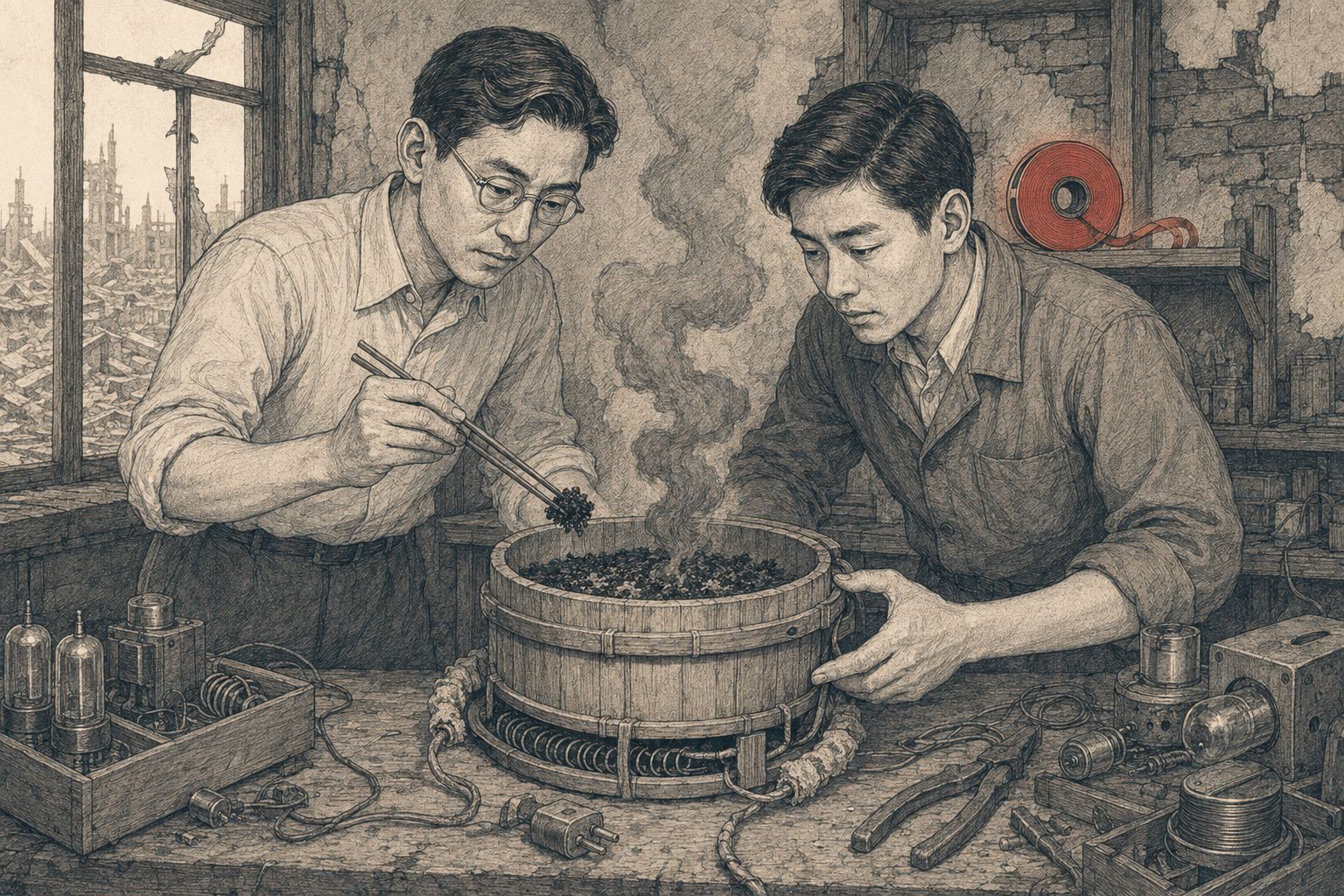
In May 1946, in a corner of a fire-scarred department store in bombed-out Tokyo, engineer Masaru Ibuka founded a company with about twenty employees and very little idea what it would sell. Its founding prospectus promised something grander than any product: an ideal factory where engineers could work with joy. The young physicist Akio Morita soon joined him as co-founder of Tokyo Tsushin Kogyo — Totsuko for short.
Postwar Japan was hungry, in every sense, and the founders reached for the most literal opportunity: rice. Their first consumer product attempt was an electric rice cooker — a wooden tub with aluminum electrodes in the bottom. Its output depended on the rice, the water and luck: undercooked one batch, scorched the next. Roughly a hundred were built. Practically none could be sold.
The early product roster got stranger before it got better. To bring in cash, the company made electrically heated cushions — so prone to scorching that they sold them under a different name, unwilling to risk the young firm's reputation on a pillow that singed its owners. Meanwhile the actual business keeping the lights on was unglamorous: repairing radios, and building shortwave adapters for them.
The founders' bet was that the company's future lay in doing what nobody in Japan had done. In 1950, after ferocious effort — including inventing their own magnetic tape from paper coated with hand-ground magnetic powder — they shipped Japan's first tape recorder, the Type-G. It weighed as much as a suitcase full of bricks and cost more than most people earned in months. Nobody bought it either.
This time, though, the product worked; what failed was the story. So Morita went out and found one: Japan's courts, drowning in stenographer shortages, and its schools discovered they needed exactly this machine. Morita later distilled the episode into his core commercial philosophy — a new product alone means nothing; you must teach the market what it is for. Selling, he had learned, was invention's second half.
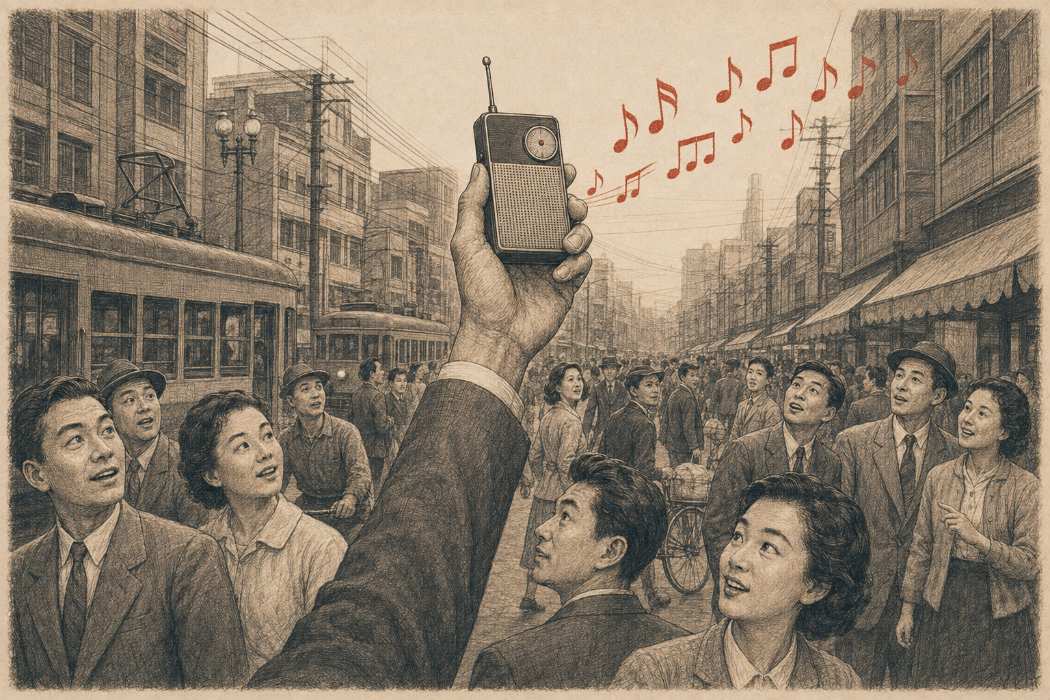
The leap came in 1953-54, when the company licensed a strange American invention — the transistor — from Bell's Western Electric, and set out to do what its inventors doubted made sense: build radios around it. The TR-55, Japan's first transistor radio, arrived in 1955; the 'pocketable' TR-63 followed — slightly larger than a shirt pocket, which the company solved by sewing its salesmen shirts with bigger pockets.
In 1958 Totsuko renamed itself Sony, and the company that had burnt Tokyo's rice went on to define consumer electronics for half a century: the Trinitron television, the Walkman, the compact disc, the PlayStation. Morita became one of the century's great industrialists, the man who made 'Made in Japan' mean precision instead of cheapness.
The wooden rice cooker survives in Sony's corporate archive, displayed with something close to pride. It earned the spot: it is the physical proof of the founding doctrine — the first product can fail completely, so long as the ambition it embarrassed keeps working.
Questions
What was Sony's first product?
An electric rice cooker: a wooden tub with aluminum electrodes in the bottom. It was the first consumer product attempted by Tokyo Tsushin Kogyo, the company Masaru Ibuka and Akio Morita co-founded in Tokyo in 1946, which later became Sony.
How many Sony rice cookers were sold?
Practically none. Tokyo Tsushin Kogyo built roughly a hundred, but the results depended on the rice, the water and luck: one batch came out undercooked, the next scorched.
When did Tokyo Tsushin Kogyo become Sony?
In 1958, when Tokyo Tsushin Kogyo, or Totsuko, renamed itself Sony. Before that it had shipped Japan's first tape recorder, the Type-G, in 1950 and Japan's first transistor radio, the TR-55, in 1955.