Harland Sanders' first sixty years read like a manual of American precariousness. Born in Indiana in 1890, he was cooking for his younger siblings at six after his father died. He worked as a railroad fireman, an insurance salesman, a ferry operator, a tire salesman — a résumé of restarts, several ending in a firing, at least one in a fistfight.
The restart that stuck began at a Shell station in Corbin, Kentucky, in 1930. Sanders started feeding hungry travelers off his own dinner table in the back room, and the cooking outgrew the gasoline: over the years the sideline became Sanders Court & Café, a proper stop with a motel attached. The state's governor made him an honorary Kentucky Colonel — a title he would eventually turn into a costume, and the costume into a brand.
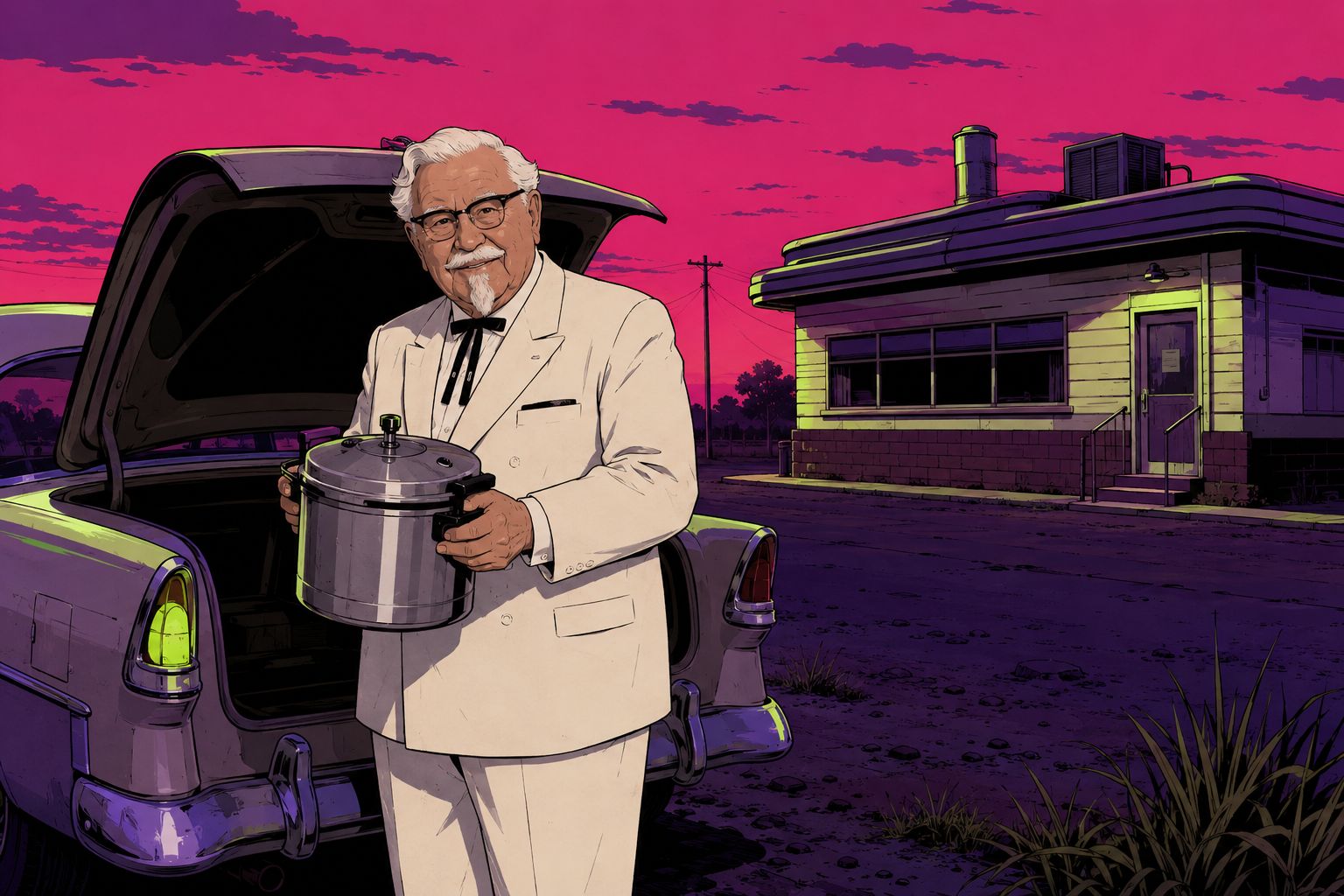
His obsession was fried chicken, and his breakthrough was industrial: the newfangled pressure cooker, which he adapted in 1939 to fry chicken fast without drying it out, sealed with the seasoning blend of eleven herbs and spices he guarded like a state secret. The café earned a listing in Duncan Hines' national dining guide. By his early sixties, Sanders was a modestly prosperous man with one restaurant, one motel and one recipe.
Then the road moved. The new Interstate 75 was routed to bypass Corbin, and the traveling traffic that was the café's entire customer base was about to move to the new highway. The business that had taken a quarter-century to build lost its value in advance; in 1956, more than a decade before the interstate around Corbin opened, Sanders sold the property at auction for $75,000 — enough, roughly, to clear his debts. He was sixty-five years old, living substantially on a monthly Social Security check of about $105.
But he was not starting from zero, and he knew it. A few years earlier he had struck a handshake deal with a Utah restaurateur named Pete Harman: Harman fried chicken the Colonel's way, called it Kentucky Fried Chicken, and paid a few cents on every bird sold. The bypass turned that side experiment into the whole plan. Sanders loaded his car with pressure cookers and seasoning and drove.
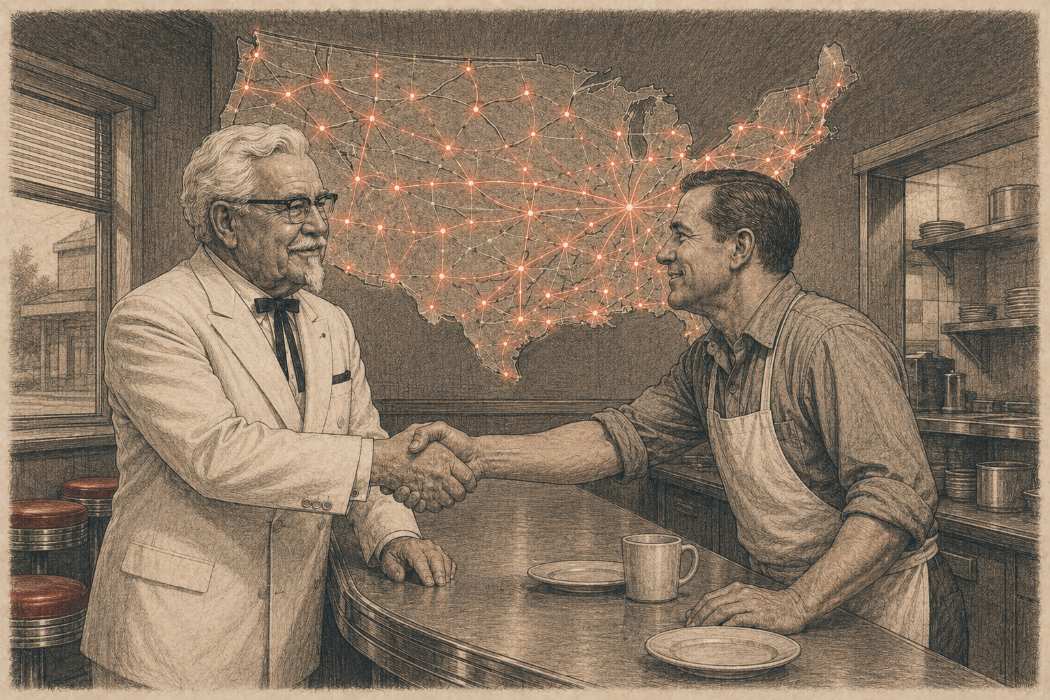
The pitch was performed, not presented: he would arrive at a diner, cook his chicken for the owner and staff, and leave either with a franchise handshake — a nickel a chicken, no lawyers — or with nothing but gas expenses. Sleeping in his car between towns, the white-suited old man collected refusals by the hundred and believers one kitchen at a time.
The believers compounded. By the early 1960s there were more than six hundred Kentucky Fried Chicken outlets across North America, and the operation had outgrown its founder's glove compartment. In 1964, at seventy-three, Sanders sold the company to a group led by John Y. Brown Jr. and Jack Massey for $2 million, staying on as its living trademark — and its loudest quality inspector, famously willing to condemn a franchisee's gravy to his face.
He spent the rest of his life in the white suit, the most recognizable founder-mascot on earth. The arc never loses its force: the highway took his restaurant at sixty-five, and the recipe in the trunk turned out to be worth more than everything the road had taken.
Questions
How old was Harland Sanders when he started KFC?
Sixty-five: in 1956 Harland Sanders auctioned off his café in Corbin, Kentucky, and took to the road selling franchises. Until then Kentucky Fried Chicken had been a side experiment, a handshake deal with Utah restaurateur Pete Harman.
Why did Colonel Sanders lose his restaurant?
The new Interstate 75 was routed to bypass Corbin, Kentucky, threatening to cut off the travelers who were Harland Sanders' entire customer base. In 1956, long before the highway opened, he sold the café at auction for $75,000, roughly enough to clear his debts.
How much did Colonel Sanders sell KFC for?
$2 million: in 1964, at seventy-three, Harland Sanders sold the company to a group led by John Y. Brown Jr. and Jack Massey and stayed on as its living trademark. By the early 1960s there were more than six hundred Kentucky Fried Chicken outlets across North America.