
On September 1, 1945, Sam Walton, 27 and just out of the Army, opened his first store: a Ben Franklin variety store on Front Street in Newport, a cotton and railroad town of about 7,000 people in the Arkansas Delta. It cost $25,000 — $5,000 of his and his wife Helen's own money and $20,000 borrowed from her father, L. S. Robson. By his own admission, Walton had never spent a day running a variety store.
Only after the deal closed, he wrote, did he learn that the store was "a real dog." It sold about $72,000 a year, paid the highest rent anyone in the variety business had heard of — 5 percent of sales — and faced a strong competitor across the street, John Dunham's Sterling Store. Walton set himself a goal anyway: within five years, the best and most profitable variety store in Arkansas.
“I blamed myself for ever getting suckered into such an awful lease, and I was furious at the landlord.”
Sam Walton, 'Made in America' (1992)He got there partly by bending the franchise rules. Butler Brothers, the company behind Ben Franklin, required him to buy at least 80 percent of his merchandise through it; Walton found cheaper suppliers anyway. A New York agent, Harry Weiner, sold him ladies' panties at $2 a dozen, against the $2.50 Ben Franklin charged, so a line that had sold at three pairs for $1 could go out at four. When Kroger left the building next door to Dunham's store, Walton hurried to Hot Springs, talked its landlady into giving him the lease instead of Sterling, and opened a small department store there, the Eagle Store.
The numbers followed. Sales rose to $105,000 in the first year, then to $140,000 and $175,000, and after two and a half years he had repaid his father-in-law. By the fifth year the store was selling $250,000 a year and making $30,000 to $40,000 in profit. By Walton's account it was the number-one Ben Franklin store, for sales or profit, in its whole six-state region.
Then the lease ran out. "In all my excitement at becoming Sam Walton, merchant," he wrote, he had neglected to include a clause giving him an option to renew after the first five years. His landlord, P. K. Holmes, owned one of Newport's department stores. Impressed by the Ben Franklin's success, Holmes refused to renew at any price, knowing there was nowhere else in town to move the store. He did offer to buy the franchise, fixtures and inventory at a fair price: he wanted the store for his son.
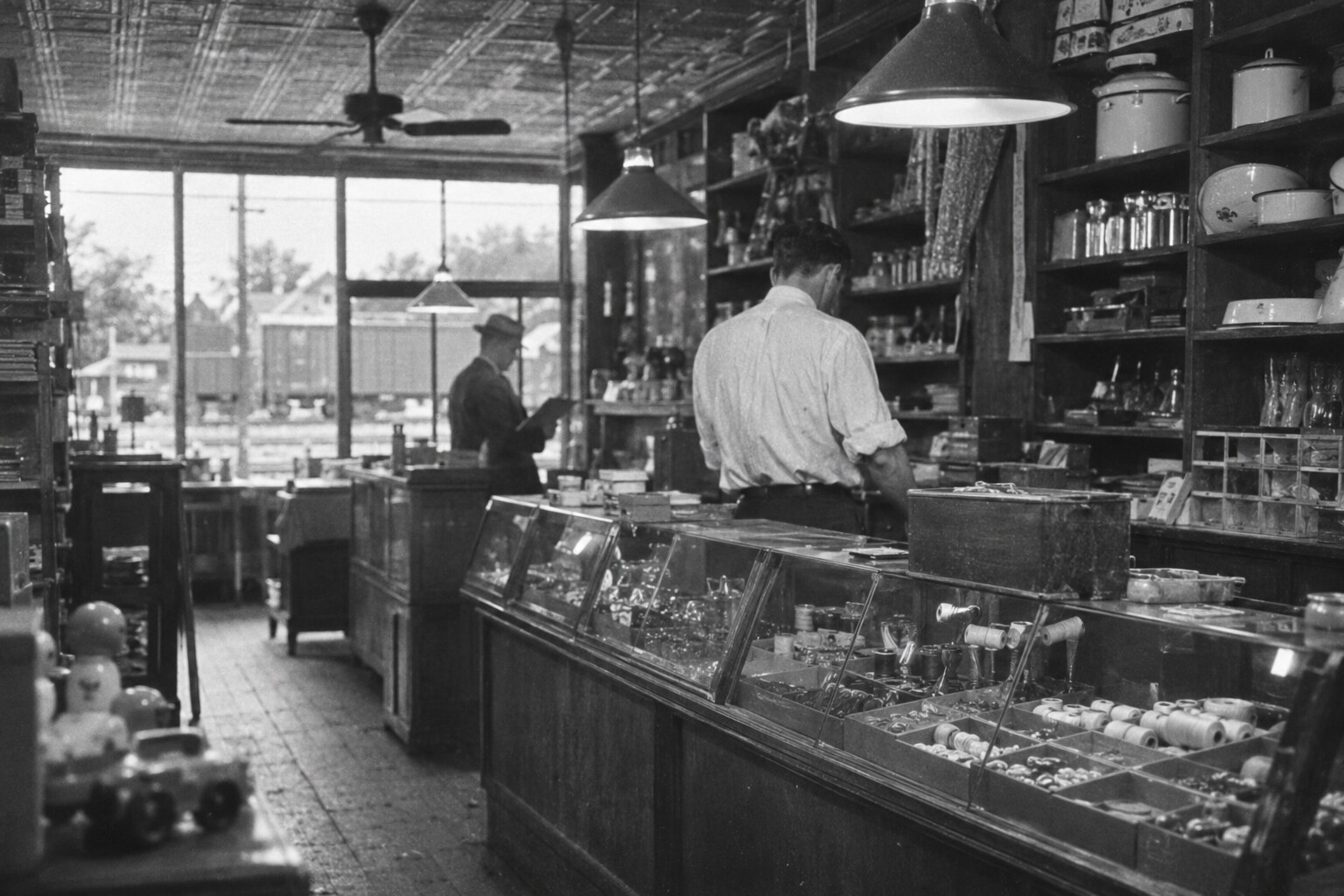
Walton had no alternative but to give it up. He sold the Eagle Store lease to Sterling, so that Dunham, "my worthy competitor and mentor," could finally have the expansion he had wanted. "It was the low point of my business life," Walton wrote. "I felt sick to my stomach." He had built the best variety store in the region, he added, and was being "kicked out of town," with Helen and four small children.
He did not dwell on it, he wrote. The sale brought him more than $50,000 and a new habit: "I know I read my leases a lot more carefully after that." It may have been about then, he added, that he began encouraging his oldest boy, six-year-old Rob, to become a lawyer. Rob did become one, and from 1992 to 2015 he chaired Walmart's board.
In 1950 the Waltons moved to Bentonville, a town of about 3,000 in the northwest corner of the state: Helen wanted small-town life, and Sam liked having the hunting seasons of four states within reach. On the square he bought a variety store that had sold just $32,000 the year before and reopened it as Walton's 5&10, still a Ben Franklin franchise. He rode a bus all night to see two Minnesota stores that had gone self-service and laid out his the same way; by his account it became only the third self-service variety store in the country. The Walmart Museum now occupies the same space on the square.
By 1960 the Waltons had fifteen stores with $1.4 million in annual sales. On July 2, 1962, at 44, Sam Walton opened the first Walmart in Rogers, just down the road from Bentonville. For the fiscal year that ended in January 2026, Walmart reported $713.2 billion in revenue.
Questions
Why did Sam Walton lose his first store?
Because his lease could not be renewed. Sam Walton had neglected to include an option to renew after five years, and in 1950 his Newport landlord, P. K. Holmes, refused to extend it at any price: he wanted the store for his son.
How much did Sam Walton pay for his first store?
$25,000: in 1945 Sam Walton bought a Ben Franklin variety store in Newport, Arkansas, with $5,000 of his own money and $20,000 borrowed from his father-in-law. Within five years its sales grew from about $72,000 a year to $250,000.
When and where did the first Walmart open?
On July 2, 1962, in Rogers, Arkansas. Sam Walton, then 44, opened it twelve years after losing his Newport store, having started over in nearby Bentonville with Walton's 5&10.
Sources
- Sam Walton with John Huey, Sam Walton: Made in America (Doubleday, 1992) — Internet Archive
- Richard S. Tedlow, "Sam Walton: Great From the Start" — Harvard Business School Working Knowledge, 2001
- Walton, Sam — Encyclopedia of Arkansas
- Walmart Inc. — Encyclopedia of Arkansas
- Sam Walton — Walmart
- Walmart History — Walmart