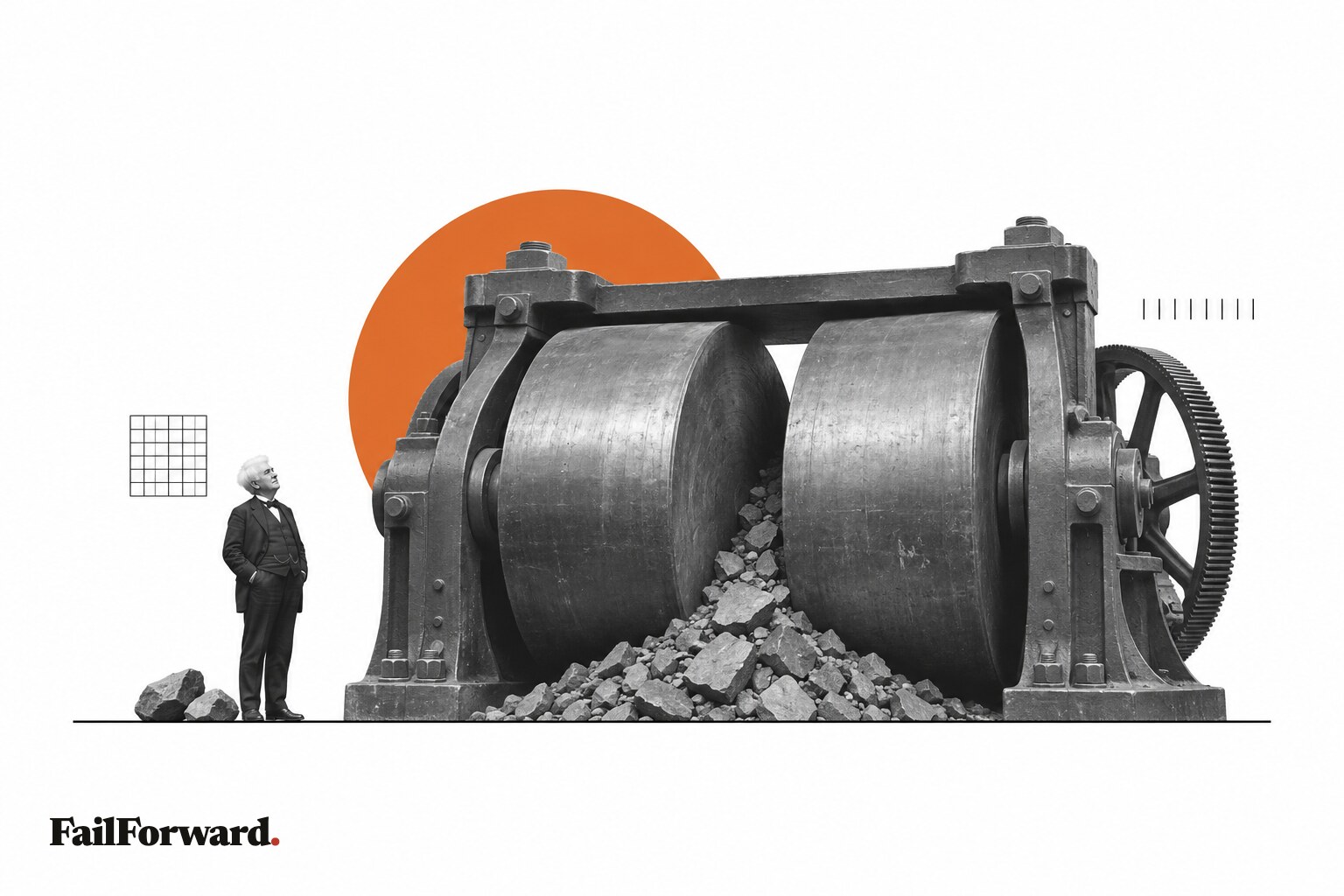
The rolls at Thomas Edison's ore works in the hills of northwestern New Jersey were two solid cast-iron cylinders, six feet across and five feet long, built to break boulders of five or six tons. They were the first stage of what his 1910 biography called 'the most colossal experiment that he has ever made': a plant near Ogdensburg that would crush low-grade rock, pull the iron out with electromagnets and press it into briquettes for eastern steel mills.
More than $2 million went into the plant, much of it Edison's own, and he sold his General Electric shares to keep it going. In 1902, on the way home from Edison's new cement plant, his associate Walter Mallory showed him that day's General Electric price, near its peak of about $330. What would his shares be worth, Edison asked, had he never sold? 'Over four million dollars,' Mallory worked out. Edison tugged at his right eyebrow for fifteen or twenty seconds. Then, Mallory recalled, his face lit up.
“Well, it's all gone, but we had a hell of a good time spending it.”
Thomas Edison in 1902, as recalled by his associate Walter S. MalloryThe venture was no whim. Edison's first patent, granted in June 1869, had shown him what an unwanted machine is worth: an electrographic vote recorder that tallied a legislature's yeas and nays at the turn of a switch. In Washington, as Edison told it, a committee chairman watched it work and said: 'Young man, if there is any invention on earth that we don't want down here, it is this.' Slow roll calls, he explained, were a minority's weapon against bad bills. Edison resolved, his biographers wrote, to invent only things for which there was 'a real, genuine demand.'
Iron ore passed that test. By 1890, a National Park Service history notes, the eastern states had exhausted their high-grade ore, and Edison held patents on separating the low-grade kind with magnets. His New Jersey and Pennsylvania Concentrating Works, organized in December 1888, built the plant and a company village later renamed Edison (not today's Edison, New Jersey). Then came breakdowns, and the depression of 1893 stalled the steel trade; Edison spent much of the decade redesigning.
What finished it lay in Minnesota. On the Mesabi Range, rich ore sat near enough the surface for open pits and went east cheaply across the Great Lakes. By the biography's figures, ore fell from about $6.50 a ton to $3.50; Edison had planned on at least $6. The works shut for good in 1900. Edison would not let the company default — no company he had been actively involved in, he said, had ever failed to pay its debts — and clearing several hundred thousand dollars took about three years.
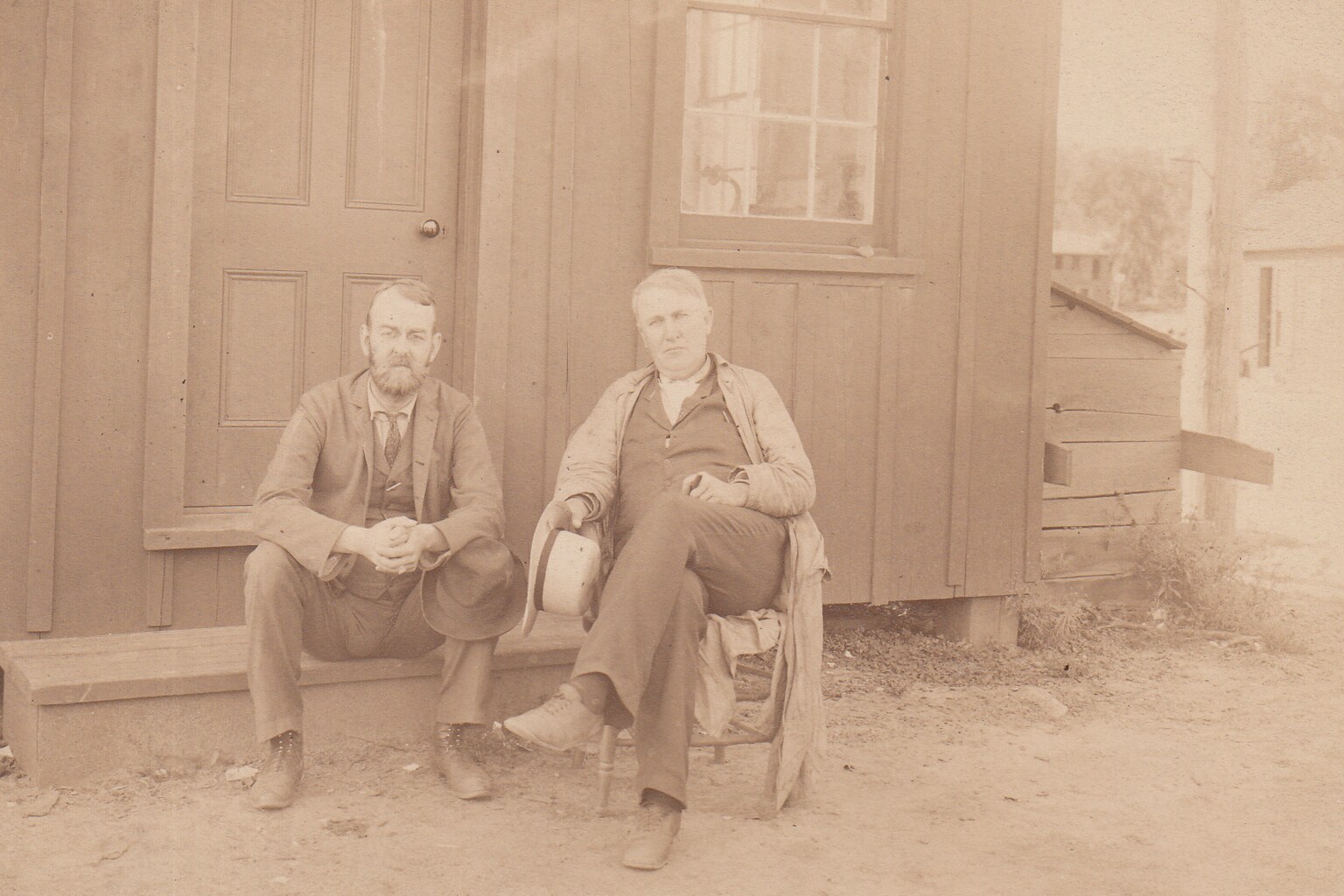
On the train home after they decided to give up, Mallory recalled, Edison said they must put what they had learned to practical use. The use was cement, which also starts with crushing rock. The Edison Portland Cement Company, incorporated in June 1899, was built on his crushing rolls and air separation, with kilns 150 feet long when the standard was 60 to 80. In 1922 and 1923 it supplied the cement for the original Yankee Stadium. It was no quick fortune: by one account, its first profitable year was 1922.
Edison's best-known line on failure, 'I have not failed. I've just found 10,000 ways that won't work,' is a later polish. He did hold the idea: in 1882 he wrote of 'the enormous number of things that won't work.' But Quote Investigator traced the scene behind it to Mallory. In 1900 Edison began a new storage battery; more than five months and over nine thousand experiments in, Mallory asked whether it wasn't a shame to have no results. 'Results! Why, man, I have gotten a lot of results! I know several thousand things that won't work.' In the sources it collected, 10,000 first appears in 1982, half a century after Edison's death.
Mallory's version is less quotable and more useful: it counts failed experiments as results. At Ogdensburg the results were rolls that could swallow a boulder, machinery that moved immense masses of rock automatically, and a cement business that outlived its founder; its successor was still making cement in 1942.
Questions
How much money did Edison lose on iron ore?
More than $2 million, much of it his own fortune. Cheap ore from Minnesota's Mesabi Range made his New Jersey works uneconomic, and they shut for good in 1900.
Was Yankee Stadium built with Edison's cement?
Yes. The Edison Portland Cement Company, which grew out of the rock-crushing technology of Edison's failed ore mill, supplied the cement for the original Yankee Stadium, built in 1922 and 1923.
Did Edison really say he found 10,000 ways that won't work?
Not in those words. The earliest account of the scene, in a 1910 biography, has him say during his storage-battery work: 'I know several thousand things that won't work.' In the sources Quote Investigator collected, the 10,000 version first appears in 1982.
Sources
- Frank L. Dyer and Thomas C. Martin, Edison: His Life and Inventions (1910), full text
- Quote Investigator: I Know Several Thousand Things That Won't Work
- National Park Service, Beehives of Invention: Edison and His Laboratories (1973)
- Thomas Edison National Historical Park: Muckers and Ore Milling
- Thomas A. Edison Papers, Rutgers: New Jersey and Pennsylvania Concentrating Works
- Edison and Ford Winter Estates: Cemented in History